

I’m all for metaphors. If variety is the spice of life then metaphors are the smoked paprika of language. I just made a metaphor out of a metaphor; that’s how highly I regard them.
But my veneration for the figurative extends only so far.
Like so many things sucked into the corporate vortex, metaphors become significantly less delectable once appropriated by the Organisational and Regulatory Group for Aligned and Strategic Management (ORGASM), or whatever the central workplace buzzword creation committee is called in your region.
Here’s an example.
Just before I quit my job to become a full-time dispenser of wit and disparagery, I was asked to do something I’d never been asked to do before.
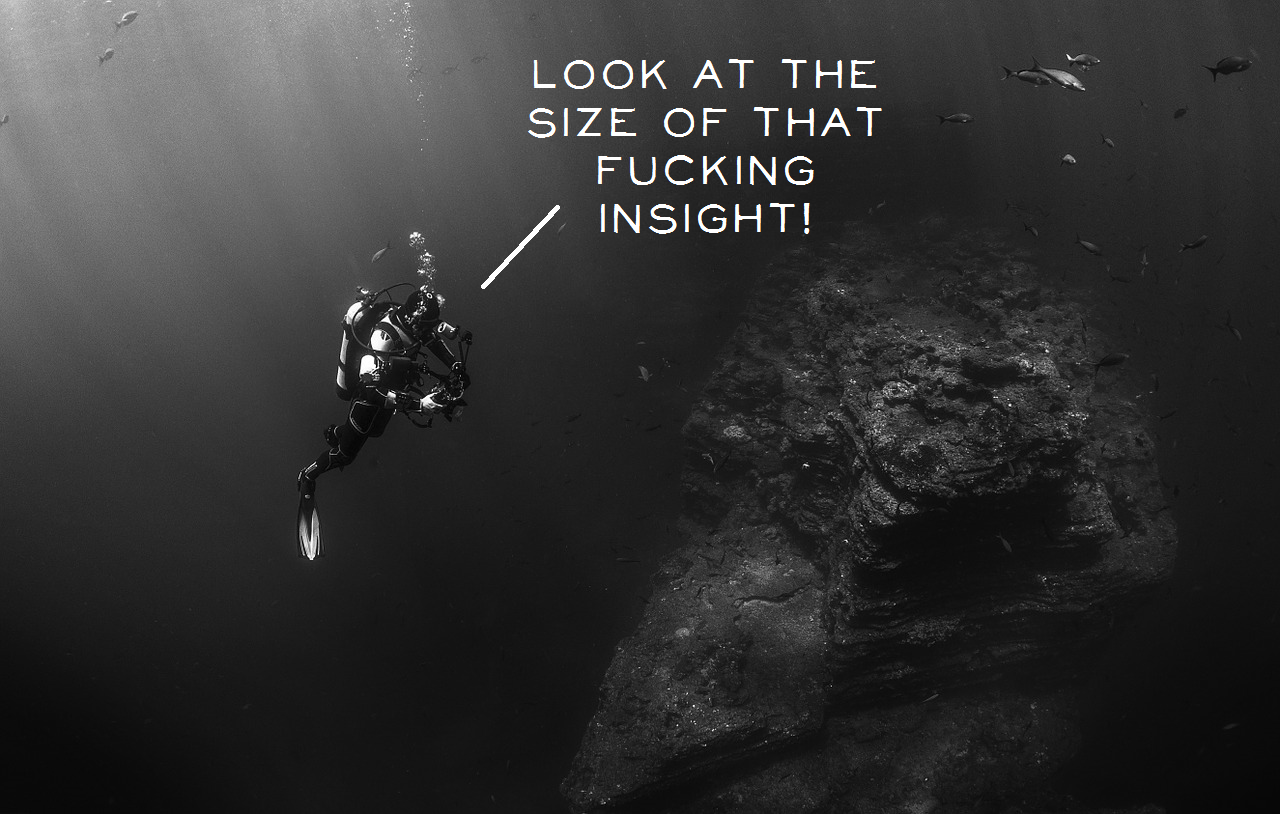
I was asked to take up deep diving.
I was told I needed to deep dive into data, metrics, “the numbers” and analytics. These were, as far as I knew, all exactly the same thing.
I was also asked to dive deep into quarterly results, prolix emails, strategy documents and even my own performance.
I didn’t know what that meant, so I did some thorough research. (It turned out I deep dived into deep dives.) Deep dives were, and still are, apparently, an antidote to an evermore facile world, a world dominated by superficial vocational snorklers.
The theory goes that those who take the time to put on their scuba suits and delve profoundly into a problem are the ones most likely to return to the surface with that most precious of corporate treasures: “real insights”.
The paradoxical problem is, as with all corporate metaphors, “deep dive” is now employed almost exclusively by the aforementioned snorklers. Or, worse, people barely out of life’s kiddie pool, despite often being in their 30s, 40s or 50s. And it’s employed by thousands of them. Hundreds of thousands of them, probably. Daily. Repeatedly. In offices across Australia.
Yes, “deep dive” makes me want to hold my breath, but not to prepare myself for a non-literal plunge. But because it reeks. It reeks of hollow cliche, which is exactly what it has become.
An edited version of this article first appeared in the MyCareer section of The Age and Sydney Morning Herald.
You can read the column – Benign to Five – in those papers every Saturday, and if you miss it, you can look it up online in the Workplace section of The Age, the Sydney Morning Herald, The Canberra Times, WAToday and Brisbane Times. (I now wankishly call myself a “syndicated columnist” on my CV.)